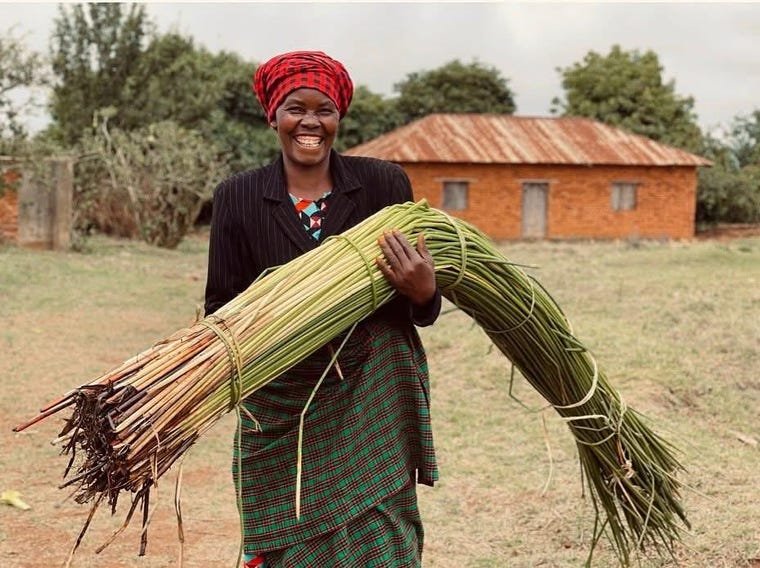
Every Fortress of Blessing bag starts a long way from Denver. It starts on a riverbank in the southern highlands of Tanzania, with a woman bending to cut a bundle of grass. By the time the bag reaches you, it has passed through many hands, and every one of them left something of themselves in the weave. Here is how it happens.
It begins with milulu grass
Our baskets are woven from milulu grass, a tall, reed-like grass that grows along certain rivers in Tanzania’s southern highlands. Gathering it is real work. The women walk out to the riverbanks, cut the grass by hand, and carry the heavy bundles back to their villages.
Then the grass is laid out to dry in the sun. Drying is what makes it strong and supple enough to weave, and it is why a finished basket can carry groceries, books, or a day at the beach and still hold its shape for years.
A tradition from Iringa
In the Iringa region, where our founder Fariji was born, baskets are not decorations. They are everyday tools. Families use them for market days, for carrying food, and for taking grain to the mill. Iringa baskets are a long tradition of the Hehe people, and the skill has been passed down for generations.
For a while, that tradition was fading. Weaving took days, and there were few places to sell the baskets for a fair price. That is where Vikapu Bomba comes in.
The women of Vikapu Bomba
Vikapu Bomba, which means “fantastic baskets” in Swahili, was founded in Iringa in 2011 by Catherine Shembilu. She started with six weavers. Today more than 300 women across the Iringa and Njombe regions weave with Vikapu Bomba, and their baskets are sold in 21 countries.
Catherine brought the women together into small groups, helped them sharpen their skills, and found markets for their work. She also taught new designs, turning the traditional market basket into totes, backpacks and crossbody bags you can carry anywhere. Many of the women who weave our bags are widows, and this work helps them care for their families.
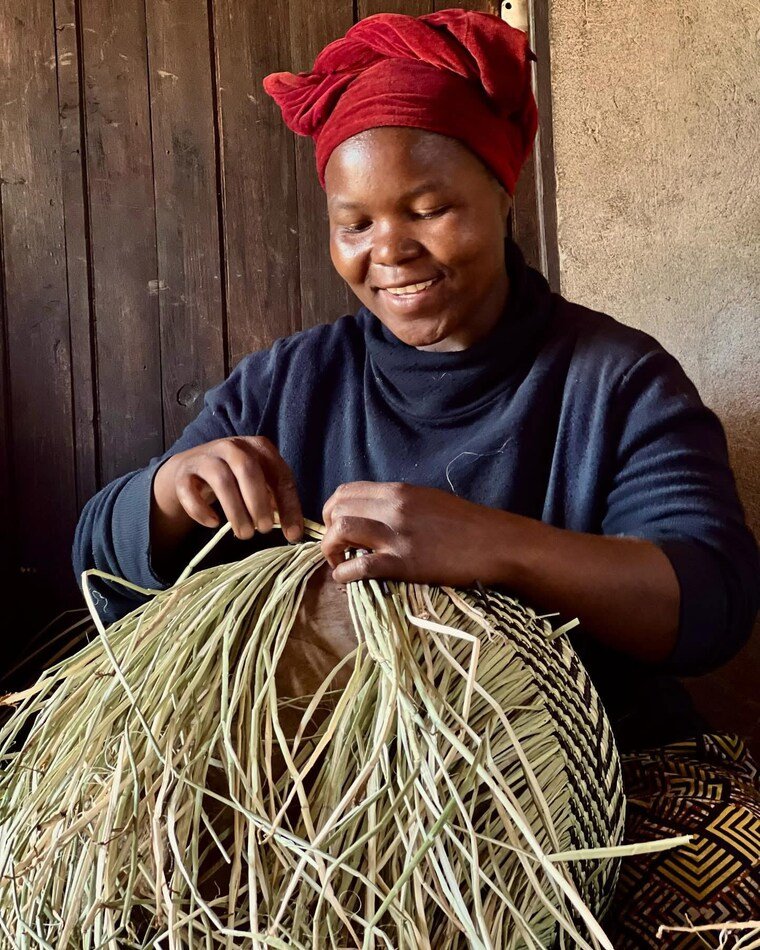
Strand by strand
The weaving itself is done entirely by hand. The weaver works the dried grass into tight, even rows, building the pattern and the bands of color as she goes. Depending on the size and design, a single basket takes days, and sometimes weeks, of careful work.
Because every basket is made by hand, no two are ever exactly alike. A slightly different shade of grass, a pattern that shifts by a row: these are not flaws. They are the signature of the woman who made it.
Finished with leather
Once the weaving is done, each bag is finished with real leather straps and handles, so it can carry real weight every day. Our backpacks have leather straps with buckles, and most of our crossbody bags have a leather flap and a long strap. Catherine’s label goes on every bag alongside ours, because we make these bags together.
From Iringa to you
From Iringa, the finished bags travel to Denver, Colorado, where Fariji packs each one by hand and ships it to its new home. When you carry one, you carry a piece of Tanzania with you, and you help a woman in Iringa earn a living with her own hands.
If you would like to see the craft up close, our Oversized Brown Market Tote shows the classic market-basket weave, and our Mustard Gold and Sage Backpack shows how the same tradition becomes something new.
Woven by hands. Blessed by tradition.